What active compression adds to cold therapy, and what the research shows.
If your surgeon or physio has suggested Game Ready after knee surgery, you may have wondered whether it does anything a bag of frozen peas can’t. It’s a fair question. Cold therapy is the foundation of both, and ice packs have a real place in recovery.
The difference is what Game Ready adds on top of the cold: controlled, intermittent compression. This article explains what that compression is meant to do and what clinical trials have found.
What cold does
Cooling the skin around a joint lowers the temperature inside it. Cooling is thought to slow nerve conduction, which may reduce pain signals. It also narrows blood vessels, which helps limit inflammation and local swelling. This is why ice is used so widely after orthopaedic surgery, and why both an ice pack and a cold compression machine can help.
What compression adds
Swelling after surgery is fluid collecting in the tissues. Compression helps move it along. External compression is thought to help blood return from the leg through the veins and to support the small lymphatic vessels that clear fluid from tissue.
There are two kinds of compression. Static compression, like a bandage or a firm sleeve, applies steady pressure. Intermittent compression inflates and releases in cycles, a bit like a gentle pumping action. Researchers who studied intermittent compression after knee ligament surgery suggest it improves microcirculation and the movement of fluid between tissues more than constant pressure does.
How Game Ready combines the two
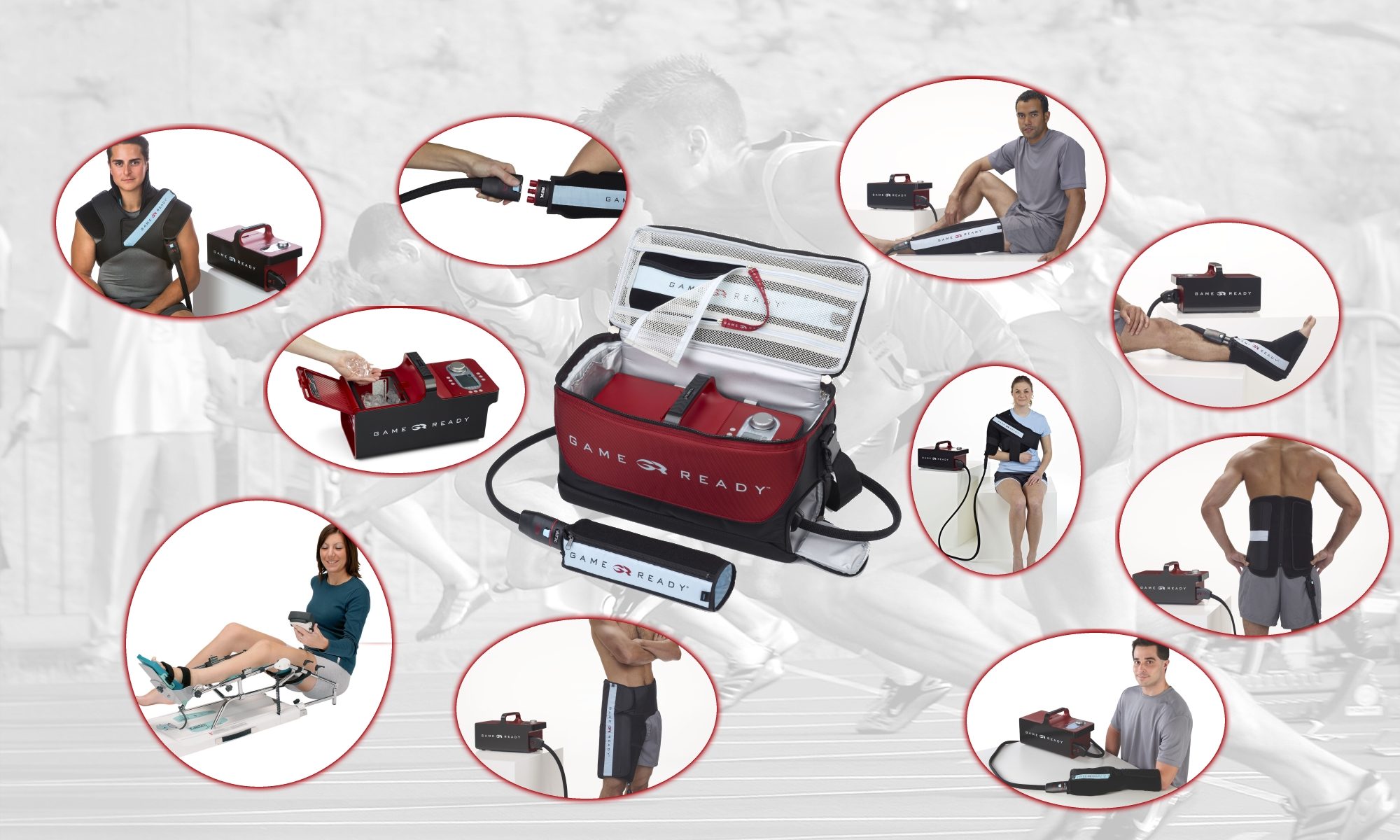
Game Ready circulates ice-cold water through a wrap fitted around the joint. The wrap also has air chambers that inflate and deflate, giving intermittent compression that can be set between 5 and 75 mmHg. Cold and compression are delivered together, all the way around the joint, at a setting you can adjust.
What the research shows
Three studies have compared Game Ready with simpler cold therapy after surgery.
Knee replacement, France (2024). Forty knee replacement patients in a rehabilitation hospital were randomly assigned to Game Ready or to cold packs during 21 days of rehab. The ice pack group used two cold packs held on with an elastic bandage for 30 minutes, three times a day. After 21 days, the Game Ready group had less fluid in the joint, less pain during activity (1 out of 10 compared with 3), and walked further in a six-minute walk test (439 metres compared with 340). They also scored better on a questionnaire about everyday function.
The Game Ready group also reached some recovery milestones sooner. By day 8, 70% had reached 90 degrees of knee bend, which is roughly what you need to sit and walk comfortably, compared with 40% in the ice pack group. By the same day, 70% had a measurable drop in swelling above the knee, compared with 10%. The researchers received no funding and declared no competing interests.
ACL reconstruction, France (2014). This study compared 39 patients at one clinic. Twenty used Game Ready with intermittent compression and 19 used a cold therapy device with static compression, and both groups followed the same pain medication plan. The Game Ready group used less than half as much tramadol (57.5 mg compared with 128.6 mg on average), none of them needed morphine, and they had more knee bend when they went home the next day (90.5 degrees compared with 84.5).
ACL reconstruction, United States (2012). Patients were randomised to a cold compression device or a standard ice pack, both used three times a day. By six weeks, 83% of the cold compression group had stopped taking narcotic pain relief, compared with 28% of the ice pack group.
So, is it just an expensive ice pack?
No. Game Ready does something an ice pack can’t: it combines cold with intermittent compression, delivered evenly around the joint. In trials, that combination has been linked with faster early progress, less pain during activity, less swelling in the joint and lower use of strong pain medication.
Sports Health has rented Game Ready units to people recovering from surgery since 2017, with courier delivery anywhere in New Zealand. Find out more Game Ready Rentals
If you are unsure about using Game Ready for your recovery then call or message us. Contact
References
- Quesnot A, et al. Randomized controlled trial of compressive cryotherapy versus standard cryotherapy after total knee arthroplasty. BMC Musculoskeletal Disorders. 2024;25:182. https://link.springer.com/article/10.1186/s12891-024-07310-7
- Murgier J, Cassard X. Cryotherapy with dynamic intermittent compression for analgesia after anterior cruciate ligament reconstruction. Orthopaedics & Traumatology: Surgery & Research. 2014;100:309–312. https://www.sciencedirect.com/science/article/pii/S1877056814000413
- Waterman B, et al. The efficacy of combined cryotherapy and compression compared with cryotherapy alone following anterior cruciate ligament reconstruction. Journal of Knee Surgery. 2012;25:155–160. https://pubmed.ncbi.nlm.nih.gov/22928433/